You have seen the triangle. Subject at one corner, object at another, mediating artifact at the top, with rules, community, and division of labor filling out the base. It gets drawn on whiteboards constantly. It appears in dissertations as a figure that no subsequent paragraph refers to.
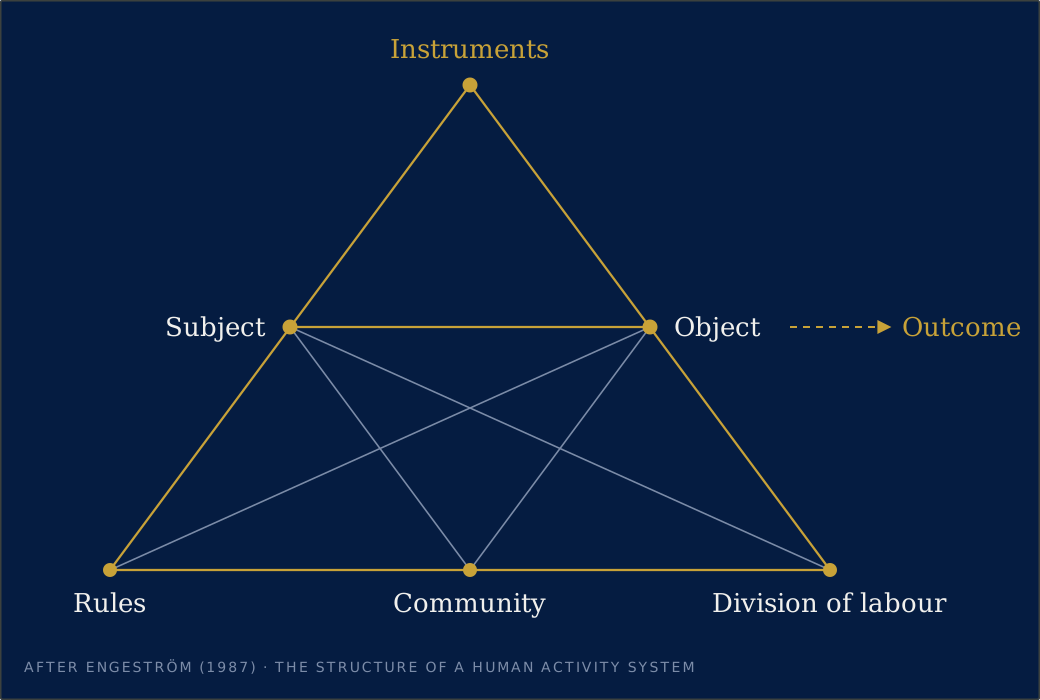
What almost never happens is someone using it to make a claim that could turn out to be wrong.
That is the symptom of a specific misunderstanding. The triangle is treated as a picture of a situation — a way of laying out the furniture of a context so nothing gets left off the list. But it was never a picture. It is a compressed argument about where explanation lives, and every version of it in the tradition's history was drawn against a previous version that someone thought was inadequate.
Read the generations that way and the whole tradition becomes easier to understand and considerably more useful.
Four arguments, each with a bill
First generation — Vygotsky. The claim: action is mediated. There is no unmediated line from stimulus to response; tools and signs stand in the middle and reorganize the whole relation (Vygotsky, 1978).
What it bought: artifacts became constitutive of thinking rather than aids to it.
What it cost: the unit stayed individual. A framework built on one person acting with one tool cannot see a hospital, a school, or a supply chain.
Second generation — Leont'ev. The claim: individual actions get their sense from the collective activity they belong to, which is oriented to an object and driven by a motive (Leont'ev, 1978).
What it bought: the social entered the unit of analysis, not as background but as the thing that makes actions interpretable at all.
What it cost: an account of the individual inside all that collectivity. Blunden (2010), tracing the tradition's philosophical lineage, is direct that this generation has trouble with identity — and reads it as substantially written from the standpoint of those who organize and manage social activity rather than those inside it.
Third generation — Engeström. The claim: put two activity systems side by side, each with its own rules, community, and division of labor, and study what happens where they meet — the partially shared object, the boundary crossing, the contradiction between them (Engeström, 1987/2015; Engeström, 2001).
What it bought: inter-organizational analysis, which is where most contemporary work actually happens.
What it cost: precision about the object. Spinuzzi (2011) named this directly: as the concept of the object expanded to carry more and more analytic weight, it became progressively harder to bound an empirical case — a runaway object. If the object can be anything, then "the object was contested" explains everything, which is to say nothing.
Fourth generation — Engeström and Sannino. The claim: the unit has to grow again, past organizations, to heterogeneous coalitions of actors assembling around problems that no single activity system owns — homelessness, climate, public health (Engeström & Sannino, 2021; Sannino, 2020).
What it bought: relevance to the problems that actually matter.
What it bought: relevance to the problems that actually matter.
What it costs is still being negotiated, and my own view is that the field has not been candid about the size of the bill.
The trade nobody prices
Here is the pattern, stated plainly.
"Each generation of activity theory purchased explanatory reach with analytic precision, and the tradition has never openly priced the trade."
Every enlargement of the unit let the framework see something real that the previous one couldn't. Every enlargement also made it harder to say what would count as being wrong. Vygotsky's triangle is small enough to test and too small for most questions worth asking. A fourth-generation coalition analysis can encompass almost any social phenomenon, which is exactly why it is difficult to falsify.
Standard introductions present this as progress — three (now four) steps up a staircase, each superseding the last. That framing is doing the field a disservice, because it implies the earlier generations are obsolete rather than cheaper and sharper for smaller questions.
Spinuzzi's larger historical treatment makes the anti-progress reading explicit: CHAT's development is better understood as a chain of translations in which each adaptation opens new possibilities while disrupting a settlement that was working, accumulating terms and unresolved disputes about the unit of analysis as it goes. One chapter reads the fourth generation not as a theoretical advance but as an implementation of public policy — activity theory taking the shape of the Finnish institutional programs it was funded to serve. You do not have to accept that reading. I find it partly persuasive and partly ungenerous. But you should know it exists, because a tradition whose internal critics are invisible in its own introductory literature is being taught as doctrine.
On "activity theory" versus "CHAT"
A short note, since the two names get used interchangeably and the difference is informative.
"Activity theory" names the Soviet-origin lineage — Vygotsky, Leont'ev, Luria, and their students. "Cultural-historical activity theory" is largely an Anglophone consolidation, and the added words are not decoration. They are the claim: culture and history are not the setting in which activity occurs, they are inside the unit of analysis, sedimented in the artifacts and the rules and the division of labor (Cole, 1996; Cole & Engeström, 1993).
That the consolidation needed doing at all is itself a finding. Roth and Lee (2007) titled their major survey "Vygotsky's neglected legacy" — a retrieval operation, in a top education journal, three-quarters of a century after Vygotsky's death. The name CHAT marks the moment a scattered inheritance was assembled into something teachable. It also marks the moment the tradition acquired an orthodoxy, which is roughly when internal critique becomes necessary.
The question to ask instead
So: which generation should you use?
Wrong question. The generations are not competing theories of the same object; they are differently sized units for differently sized problems. Asking which is correct is like asking whether a microscope is better than a telescope.
Here is the question I think is right, and it is a question about parsimony, which is not a virtue this tradition talks about enough:
What is the smallest unit of analysis that can still see my problem?
If a student's difficulty with a tool is fully explained by the mediating artifact and the rules of one activity system, do not convene a coalition. If your phenomenon genuinely lives in the collision between a university, an employer, and a credentialing body, then a single triangle will flatten it and you need the larger unit — and you need to accept, out loud, that your findings will be correspondingly harder to test.
Choose the unit deliberately, name what the choice costs, and the triangle stops being a decorative figure. It becomes what it was drawn to be: a claim you could be wrong about.
Three companion notes take the diagrams one at a time: https://freddricklogan.com/notes/vygotsky-did-not-draw-the-triangle, https://freddricklogan.com/notes/leontev-hierarchy-is-not-a-triangle, and https://freddricklogan.com/notes/the-second-triangle-is-the-whole-point
References
Blunden, A. (2010). An interdisciplinary theory of activity (Studies in Critical Social Sciences, Vol. 22). Brill.
Cole, M. (1996). Cultural psychology: A once and future discipline. Belknap Press of Harvard University Press.
Cole, M., & Engeström, Y. (1993). A cultural-historical approach to distributed cognition. In G. Salomon (Ed.), Distributed cognitions: Psychological and educational considerations (pp. 1–46). Cambridge University Press.
Engeström, Y. (2001). Expansive learning at work: Toward an activity theoretical reconceptualization. Journal of Education and Work, 14(1), 133–156. https://doi.org/10.1080/13639080020028747
Engeström, Y. (2015). Learning by expanding: An activity-theoretical approach to developmental research (2nd ed.). Cambridge University Press. (Original work published 1987)
Engeström, Y., & Sannino, A. (2021). From mediated actions to heterogenous coalitions: Four generations of activity-theoretical studies of work and learning. Mind, Culture, and Activity, 28(1), 4–23. https://doi.org/10.1080/10749039.2020.1806328
Leont'ev, A. N. (1978). Activity, consciousness, and personality. Prentice-Hall.
Roth, W.-M., & Lee, Y. J. (2007). "Vygotsky's neglected legacy": Cultural-historical activity theory. Review of Educational Research, 77(2), 186–232. https://doi.org/10.3102/0034654306298273
Sannino, A. (2020). Enacting the utopia of eradicating homelessness: Toward a new generation of activity-theoretical studies of learning. Studies in Continuing Education, 42(2), 163–179. https://doi.org/10.1080/0158037X.2020.1725459
Spinuzzi, C. (2011). Losing by expanding: Corralling the runaway object. Journal of Business and Technical Communication, 25(4), 449–486. https://doi.org/10.1177/1050651911411040
Spinuzzi, C. (2025). Triangles and tribulations: Translations, betrayals, and the making of cultural-historical activity theory. MIT Press. https://direct.mit.edu/books/oa-monograph/5991/Triangles-and-TribulationsTranslations-Betrayals
Vygotsky, L. S. (1978). Mind in society: The development of higher psychological processes (M. Cole, V. John-Steiner, S. Scribner, & E. Souberman, Eds.). Harvard University Press.
Freddrick Logan, PhD
Educational technologist and applied researcher working across career readiness, credentialing and the systems underneath them.