The third-generation figure is two complete activity systems facing each other, each with its own instruments, rules, community and division of labour, with their objects reaching toward a third object that neither of them owns.
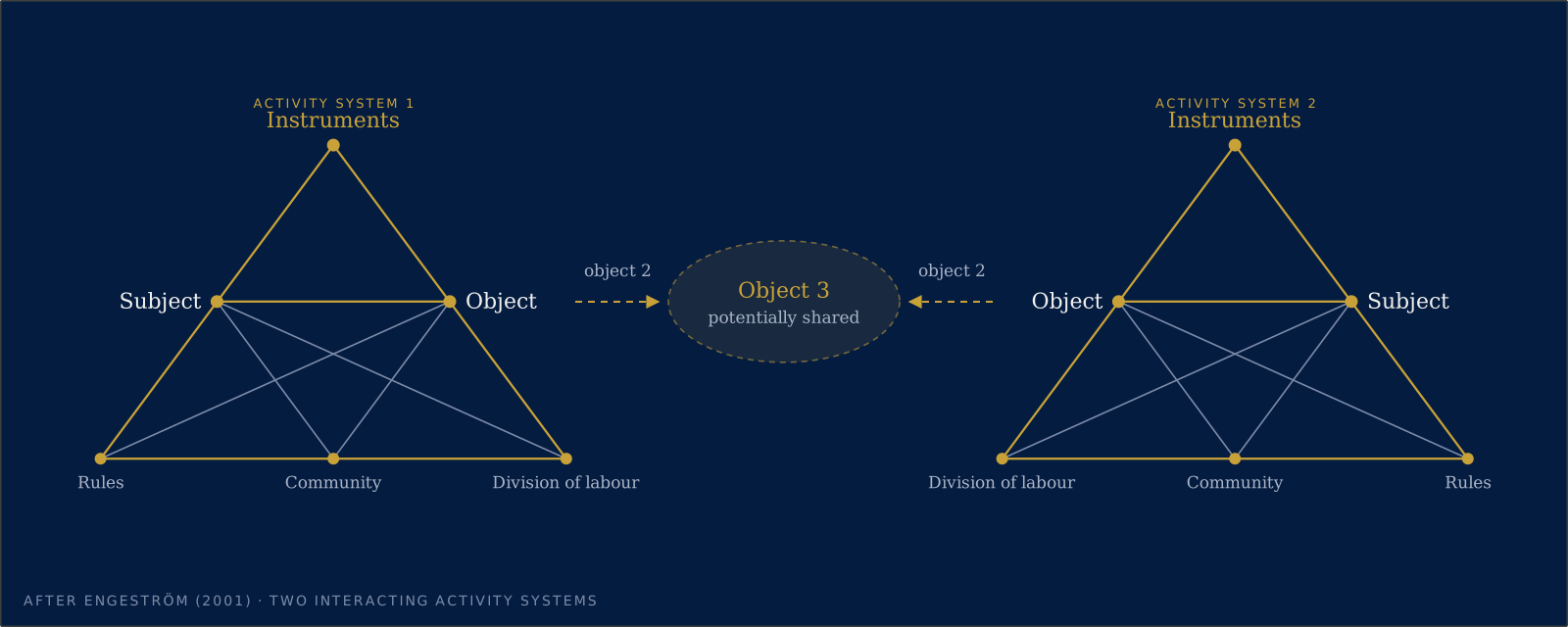
What I see in most applications is both triangles drawn faithfully and then only one of them analysed. The second system appears in the figure, is described in a paragraph, and never generates a finding. It is scenery.
Object 3 is a hypothesis
The label in the middle of that figure says "potentially shared," and the word potentially is carrying the entire argument.
The third generation does not claim that two systems working on the same problem share an object. It claims that a shared object is something that may or may not get constructed, and that whether it does is an empirical question with consequences. Two organisations can collaborate for years, produce documents together, and never build one.
This is the most useful thing in the model for anyone working across institutions, and it is the thing most often assumed away. Write "the shared object was student success" in your analysis and you have skipped the finding. Student success is what both parties said. Whether it named the same object on both sides of the table is the question you were there to answer.
Kaptelinin (2005) is the reference to have on hand, because the looseness of "object" is a known problem in the tradition rather than a fault in your case.
What a real shared object looks like
Star and Griesemer's (1989) boundary objects give the sharper version. An object working across a boundary is plastic enough to satisfy local needs on each side and robust enough to keep a common identity across them. It is not a consensus. It is a structure that lets two groups cooperate without agreeing.
Star and Griesemer's (1989) boundary objects give the sharper version.
"Cooperation without consensus is the normal case. Analyses that require agreement before they can proceed are looking for something that is not usually there."
The practical test is whether the object survives translation. Take the artifact both sides point at — the competency framework, the transcript, the internship agreement — and ask what each side would do if it disappeared tomorrow. If both answers describe the same loss, there is a shared object. If one side would be inconvenienced and the other would be released from an obligation, there is not, and everything downstream in that partnership is explained by that.
The asymmetry nobody draws
One more thing the figure hides. It is drawn symmetrically — two triangles the same size, facing each other as equals. Almost nothing in the world it models is symmetrical.
A university and an employer do not enter the shared object with equal power to define it. A workforce board and a training provider do not have the same exit costs. The system that can walk away more cheaply sets more of the terms, and the figure gives you no place to record that.
I do not think this is fatal, but it is worth annotating your own diagram when you use it: which system needs this more, and what happens to each if the collaboration ends. That asymmetry has predicted more outcomes in the partnerships I have looked at than any feature the model draws explicitly.
The bar for using two triangles
Use the second triangle when you can answer three questions about it with evidence rather than inference: what is its object, independent of the collaboration; who in it has the authority to redefine that object; and what it loses if the shared work stops.
If you cannot answer those, you do not have a second activity system. You have a stakeholder, and one triangle with an honest account of its community will serve you better and cost less.
References
Engeström, Y. (2001). Expansive learning at work: Toward an activity theoretical reconceptualization. Journal of Education and Work, 14(1), 133–156. https://doi.org/10.1080/13639080020028747
Kaptelinin, V. (2005). The object of activity: Making sense of the sense-maker. Mind, Culture, and Activity, 12(1), 4–18. https://doi.org/10.1207/s15327884mca1201_2
Spinuzzi, C. (2011). Losing by expanding: Corralling the runaway object. Journal of Business and Technical Communication, 25(4), 449–486. https://doi.org/10.1177/1050651911411040
Star, S. L., & Griesemer, J. R. (1989). Institutional ecology, "translations" and boundary objects. Social Studies of Science, 19(3), 387–420. https://doi.org/10.1177/030631289019003001
Freddrick Logan, PhD
Educational technologist and applied researcher working across career readiness, credentialing and the systems underneath them.