The equilateral triangle with Subject at one corner, Object at the other, and Mediating Artifact at the apex is routinely captioned "after Vygotsky." It is not quite his. Vygotsky's own figure in Mind in Society is a line from stimulus to response with a mediating link standing above it — a claim about interruption, not a triangle about relations. The triangle as we now draw it is a later consolidation in the Engeström lineage, tidied into a shape that could be extended downward into rules, community, and division of labour.
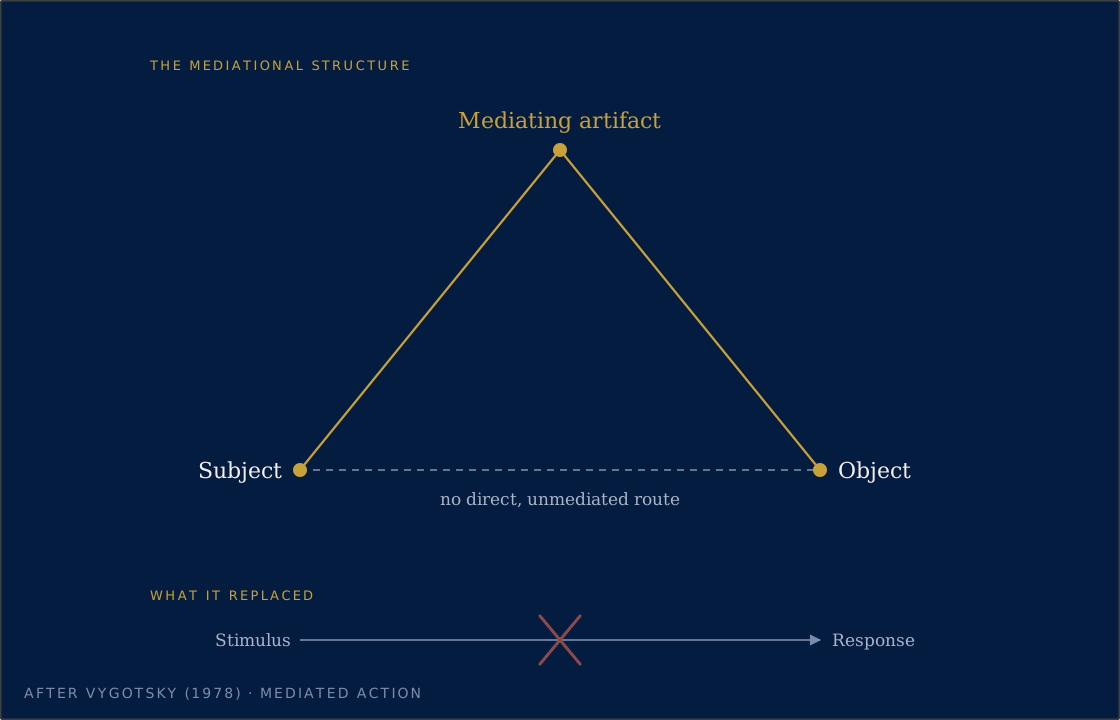
This is not a complaint about citation hygiene. The redrawing changed what the figure asserts, and knowing the difference tells you what the first generation can still do that the later ones cannot.
The claim was about a broken line
Read the figure again and notice which line is dashed. The direct route from subject to object is drawn broken because Vygotsky's claim was that it does not exist. Not that it is difficult, or usually assisted, or improved by tools. That there is no unmediated path from a person to the world they are acting on.
That is a strong claim and a falsifiable one. It says: show me an instance of goal-directed human action with no artifact or sign standing in the middle, and the framework is in trouble. Behaviourism had the direct line and nothing above it. Vygotsky's move was to insist the direct line is a fiction and everything interesting happens in the detour.
The detour is the operative word. Wertsch (1985) is careful about this: mediation is not amplification. A tool does not make the same act easier — it reorganizes the act into a different one. A person remembering a list and a person remembering a list by writing it down are not doing the same thing more or less well. They are doing two different things, and only one of them is a memory task.
What the extension cost
When the figure was redrawn as a triangle with a base, it gained the capacity to hold rules, community, and division of labour. That is a real gain and I would not undo it. But something specific was lost in the geometry.
When the figure was redrawn as a triangle with a base, it gained the capacity to hold rules, community, and division of labour.
In the original, the mediating artifact is the only thing above the line. It is structurally singular — the whole claim rests on it. In the six-node version, the artifact becomes one node among six, and the phrase "mediated by" quietly loosens: rules mediate, community mediates, the division of labour mediates. Everything mediates everything.
"When every relation in the diagram is a mediation, the word has stopped doing work."
You can see the consequence in practice. Analyses that would once have had to name a specific artifact and show how it reorganized an action now say that the activity was "mediated by institutional norms," which is a sentence that cannot fail.
When the small figure is the right one
The first generation is not a historical stage the field has moved past. It is the cheapest unit in the toolkit, and it is the correct one whenever your question is genuinely about an artifact and an action.
A student cannot use a rubric. A clinician works around the electronic record. A job seeker's resume format is fighting the applicant tracking system it is being read by. These are first-generation questions. Convening a full activity system to answer them buys you nodes you will not use and a finding you cannot test.
The test I apply: can I name the artifact, describe the action before it and the action after it, and say what changed in the structure of the act rather than its speed? If yes, the small figure is enough. If the interesting part is that two departments disagree about what the artifact is for, then I need the base, and I have moved to a different question.
References
Cole, M. (1996). Cultural psychology: A once and future discipline. Belknap Press of Harvard University Press.
Engeström, Y. (2015). Learning by expanding: An activity-theoretical approach to developmental research (2nd ed.). Cambridge University Press. (Original work published 1987)
Vygotsky, L. S. (1978). Mind in society: The development of higher psychological processes (M. Cole, V. John-Steiner, S. Scribner, & E. Souberman, Eds.). Harvard University Press.
Wertsch, J. V. (1985). Vygotsky and the social formation of mind. Harvard University Press.
Freddrick Logan, PhD
Educational technologist and applied researcher working across career readiness, credentialing and the systems underneath them.