Leont'ev's contribution to activity theory is not a shape. It is a stack, and it is regularly flattened into the triangle by people who have read a summary of both.
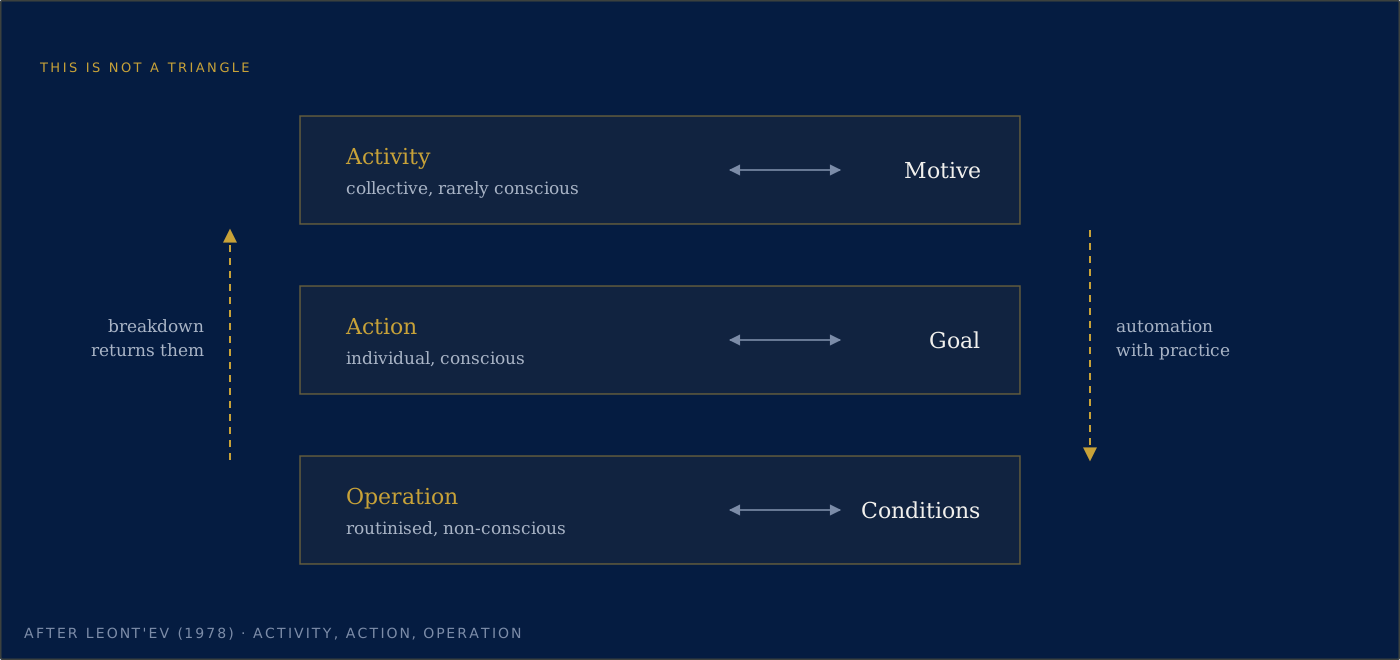
Three levels, each paired with what orients it. Activity is oriented to a motive, is collective, and is rarely available to consciousness. Action is oriented to a goal, belongs to an individual, and is conscious. Operation is oriented to conditions, is routinised, and is not conscious at all.
The levels are not a taxonomy to sort behaviours into. They are a claim about movement.
The dynamic is the whole thing
Watch the two arrows in the figure. Actions descend into operations through practice: the first time you change gear it is a goal, and after six months it is a condition of driving that you no longer notice. That descent is what skill is.
The ascent matters more analytically. When conditions break — the clutch is different, the record system changes, the interview is on camera — the operation surfaces back into the level of action and becomes conscious again. People suddenly have to think about something they had stopped thinking about.
"Breakdown is not a failure of the model. It is the mechanism that makes the model observable."
This gives you something the triangle does not: a way to locate expertise empirically. Expertise is not a quantity of knowledge. It is the depth to which actions have descended into operations, and the range of condition-changes that will not push them back up.
This gives you something the triangle does not: a way to locate expertise empirically.
What the conflation costs
When the hierarchy is folded into the triangle, the level distinction disappears, and with it the ability to say which level a finding belongs to.
I see this constantly in program evaluation. A report states that participants "struggled with the new platform." At which level? If it is operational — the muscle memory is wrong, the keystrokes have moved — the fix is practice, and the struggle will resolve without intervention. If it is at the level of action — they cannot form a goal the platform will accept — the fix is instruction. If it is at the level of activity — the motive the platform serves is not the motive they came with — no amount of training will touch it, and the program has a problem it is currently describing as a training gap.
Those three are indistinguishable in the language of the six-node triangle. They are trivially distinguishable in the language of the stack. That is the whole argument for keeping both diagrams on the desk.
The honest complication
The levels are cleaner in exposition than in data. Bakhurst (2009) is worth reading here as a sympathetic sceptic of how tidily the tradition presents its own apparatus. In a transcript you will find utterances that sit ambiguously between action and operation, and motives that are inferred rather than observed — because a motive that is rarely conscious is, by construction, difficult to evidence.
That is a real limit, and it is worth stating out loud rather than letting a clean figure imply otherwise. The stack is a lens for asking which level a difficulty lives at. It is not an instrument that returns the answer on its own.
References
Bakhurst, D. (2009). Reflections on activity theory. Educational Review, 61(2), 197–210. https://doi.org/10.1080/00131910902846916
Kaptelinin, V. (2005). The object of activity: Making sense of the sense-maker. Mind, Culture, and Activity, 12(1), 4–18. https://doi.org/10.1207/s15327884mca1201_2
Leont'ev, A. N. (1978). Activity, consciousness, and personality. Prentice-Hall.
Roth, W.-M., & Lee, Y. J. (2007). "Vygotsky's neglected legacy": Cultural-historical activity theory. Review of Educational Research, 77(2), 186–232. https://doi.org/10.3102/0034654306298273
Freddrick Logan, PhD
Educational technologist and applied researcher working across career readiness, credentialing and the systems underneath them.