Most of my week is spent with people deciding which AI tools to trust with their research: graduate students, faculty, and colleagues in student affairs who write for publication on their own time. The question usually arrives as a shopping question. Which tool should I use? I think it is a methods question wearing a shopping question's clothes.
This note makes that case using two bodies of work I have spent years inside, research on distributed work and cultural-historical activity theory, along with a small content analysis I ran this month of how AI research tools are marketed to academics.
What has actually changed
The change is no longer speculative. A Nature survey of more than 1,600 researchers in 2023 captured both enthusiasm and unease about these tools (Van Noorden & Perkel, 2023). Two years later the trace is visible in the literature itself. Liang and colleagues (2025) analyzed 1,121,912 papers posted or published between January 2020 and September 2024 and estimated how many sentences had been substantially modified by a large language model. In computer science abstracts the share rose from 2.4% just before ChatGPT's release to 22.5% (Figure 1).
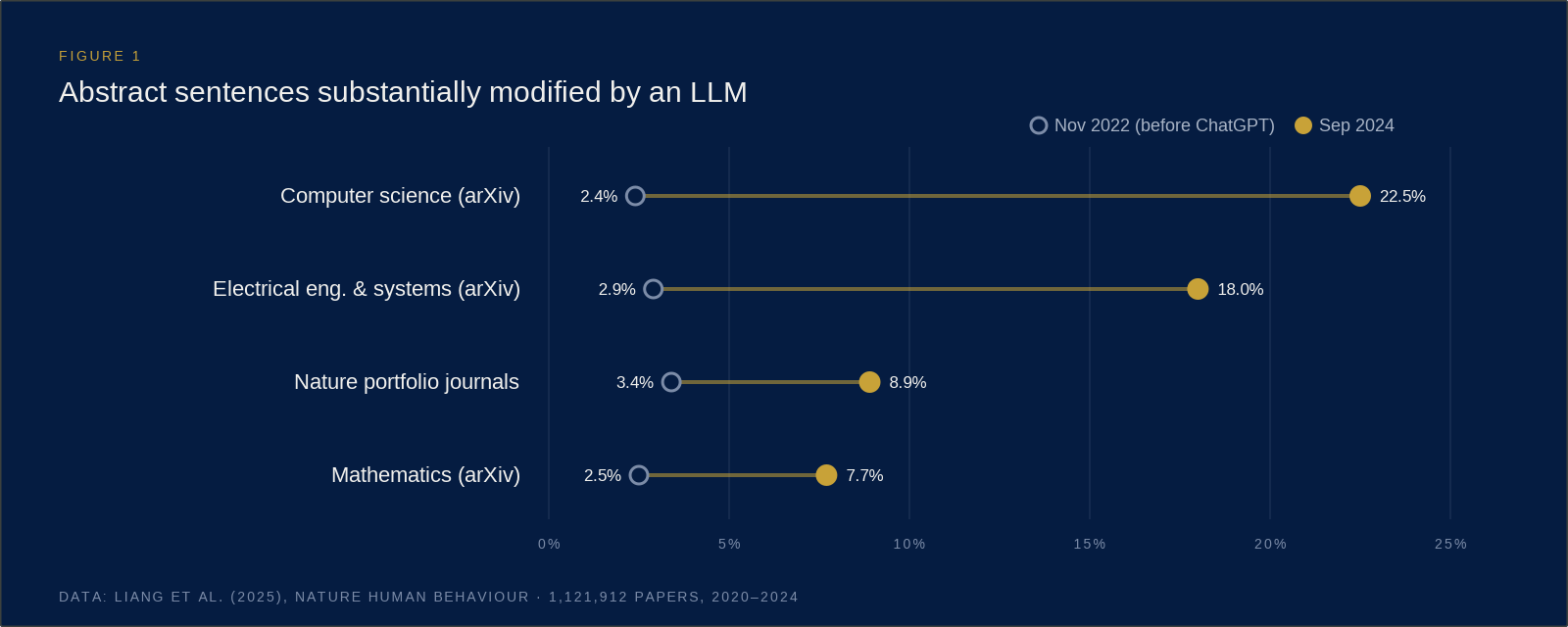
Those estimates describe language, not misconduct. A sentence polished by a model can report an entirely sound finding. What the trend does show is that the instruments of scholarly work have changed faster than most of our methods sections admit.
Research was already distributed work
Long before generative AI, research was distributed: co-authors in different time zones, shared drives, versioned drafts, a reviewer you will never meet. The distributed-work literature has described what this costs for more than two decades (Hinds & Kiesler, 2002). Olson and Olson (2000) argued that distance still matters, and named the conditions that let separated collaborators succeed: common ground, loosely coupled work, readiness to collaborate, and readiness with the collaboration technology itself.
Recent evidence refines that picture rather than overturning it. When Microsoft moved 61,182 US employees to firm-wide remote work in 2020, their collaboration networks became "more static and siloed," with fewer bridges between groups and a shift from synchronous to asynchronous communication (Yang et al., 2022). A randomized trial with 1,612 employees at Trip.com found that two days a week of working from home cut resignations by a third, with no measurable cost to performance or promotion (Bloom et al., 2024). Distribution is neither good nor bad in itself. It moves the places where coordination has to happen.
My doctoral research reached a similar conclusion about technology professionals working across corporate and educational organizations. The hard part of distributed work is rarely the tool. It is the rules, the division of labour, and the shared object the tool is supposed to serve (Logan, 2026).
Activity theorists have a name for this kind of arrangement. Engeström (2008) describes knotworking: collaboration that ties and unties quickly among loosely connected people, with no single center holding the work together. Much research now looks like that, and Blackler (1995) argued long ago that knowledge work is best understood as a distributed, mediated activity rather than as knowledge sitting inside individual heads.
Generative AI adds a new collaborator to that arrangement, and Olson and Olson's first condition fails immediately. A model has no common ground with you. It has never read your data, sat in your interviews, or answered to your participants. It produces fluent text either way.
Reading the tools as an activity system
Activity theory starts from Vygotsky's claim that there is no unmediated path from a person to what they act on (Vygotsky, 1978). Leont'ev (1978) added that an activity is defined by its object, what it is really directed at, which is not the same as the tasks people perform along the way. Engeström (1987/2015, 2001) extended the model to include the rules, community and division of labour that shape any shared activity, and argued that change comes through contradictions within and between those elements. Engeström and Sannino (2021) now describe four generations of the theory, the most recent concerned with heterogeneous coalitions of people and technologies working on shared, often global, problems.
Kaptelinin and Nardi (2006, 2018) brought the framework into interaction design for exactly this reason: a tool cannot be evaluated apart from the activity it mediates. Bligh and Flood (2017), reviewing 59 empirical higher-education studies that use activity theory, warn that it is often applied after the fact to tidy up data instead of shaping how a study is designed. I take that warning seriously here. Figure 4 is not decoration. It is an attempt to say where the tension sits.
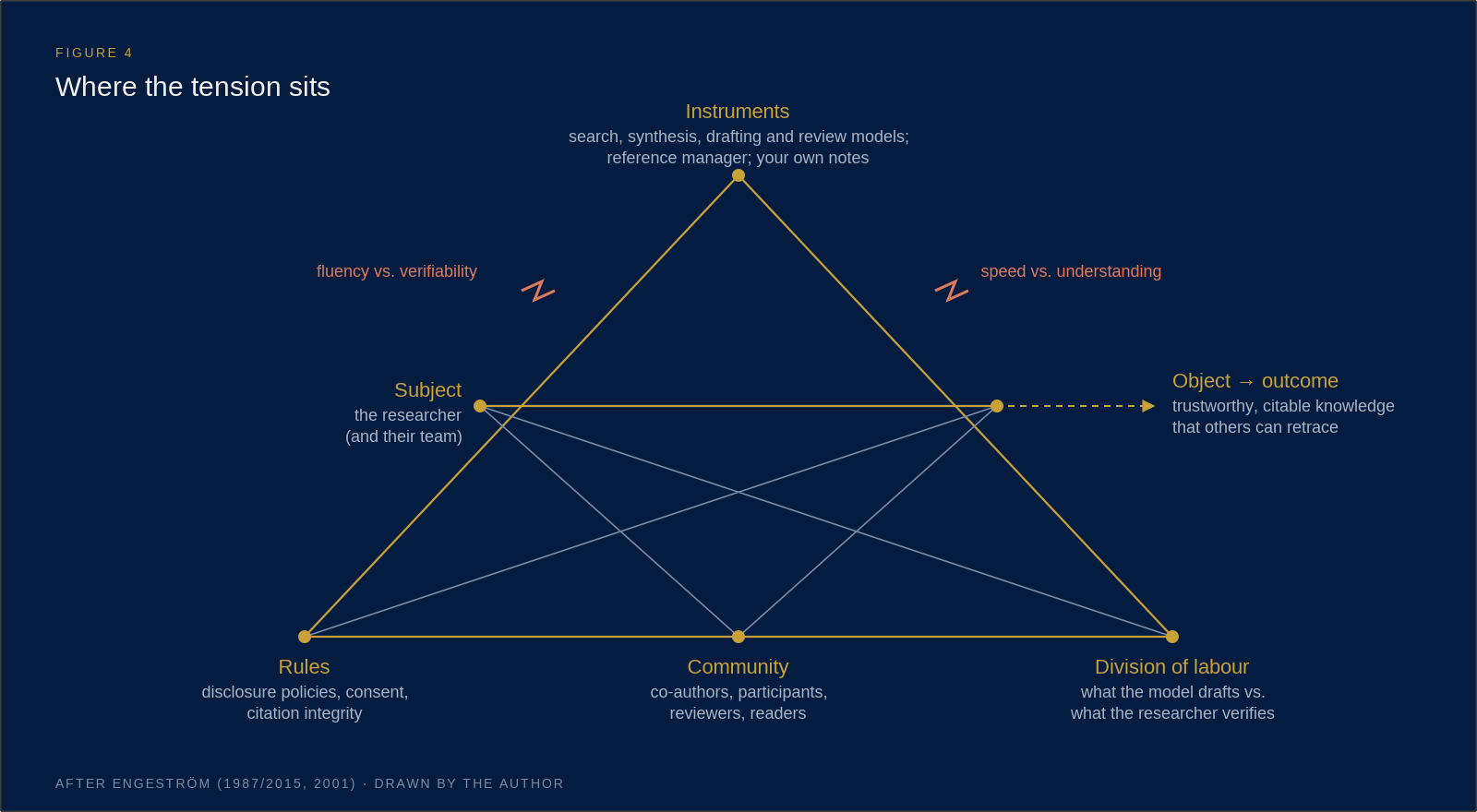
Two contradictions stand out. The first sits between instruments and rules. Language models are built for fluency, while scholarship's rules demand that every claim be traceable. The second sits between instruments and the object. A tool that makes a literature review faster can also make it shallower. Messeri and Crockett (2024) describe how researchers can slip into illusions of understanding: an illusion of exploratory breadth, where we believe we are testing every hypothesis when we are only testing what the tool can reach, and an illusion of objectivity, where we forget that a model carries its developers' standpoint.
A growing body of work now applies this lens to generative AI directly. Tai and colleagues (2026) used activity theory to identify systemic contradictions when ChatGPT entered medical learning. Lindell and Stöhr (2026) used it to build near-future scenarios for how educators will manage generative AI in higher education. Martinez Marroquin and Senadji (2025) proposed it as a framework for analysing conversational AI in workplace learning, and Li and colleagues (2025) used it to organize a systematic review of AI chatbots in language learning. The common thread is that the technology is analysed inside the activity, not as a standalone product.
Activity theory treats contradictions as the engine of change, not defects to hide (Engeström & Sannino, 2010). The productive question is not whether to use AI. It is how to redesign the division of labour so the object of the work, knowledge others can retrace, survives the new instruments.
A market, not a method
To see how researchers are being taught to think about these tools, I reviewed one widely followed academic-productivity YouTube channel in full: 680 video descriptions and 573 transcripts posted between 2017 and November 2026. I separated the tools that appear in the paid partner-link block of each description from the tools the creator names unprompted when comparing options or walking through his own workflow.
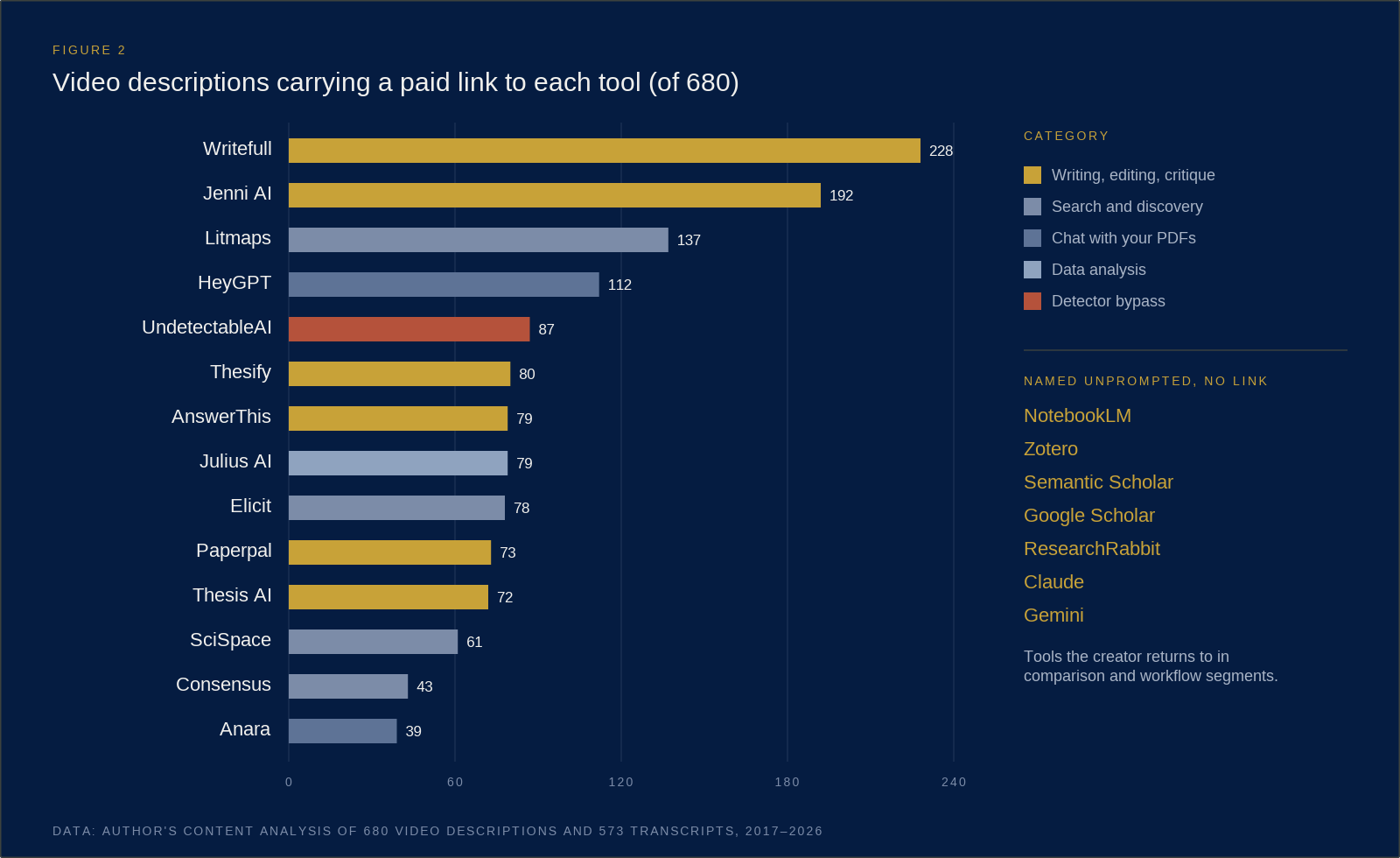
The two lists barely overlap. The most heavily linked tools help you write: autocomplete, editing, section-by-section critique. One, linked in 87 descriptions, exists to help AI-generated text avoid detection. The tools the creator returns to on camera without a link are mostly about finding and keeping track of sources, such as NotebookLM, Zotero, Semantic Scholar, Google Scholar and ResearchRabbit, alongside general models such as Claude and Gemini.
That gap is itself an activity-theory finding. A creator's channel is an activity system with its own object, its own audience and its own sponsorship revenue, and its instruments are chosen to serve that object. There is nothing wrong with that. But a researcher who borrows the toolkit without noticing the object behind it borrows the contradiction too.
Fluent is not the same as true
The verification problem is real and measurable. Walters and Wilder (2023) had ChatGPT write short literature reviews on 42 topics and checked all 636 citations. Of GPT-3.5's citations, 55% did not exist; GPT-4 cut that to 18%. Among the citations that did exist, 43% and 24% respectively contained substantive errors (Figure 3).
The verification problem is real and measurable.
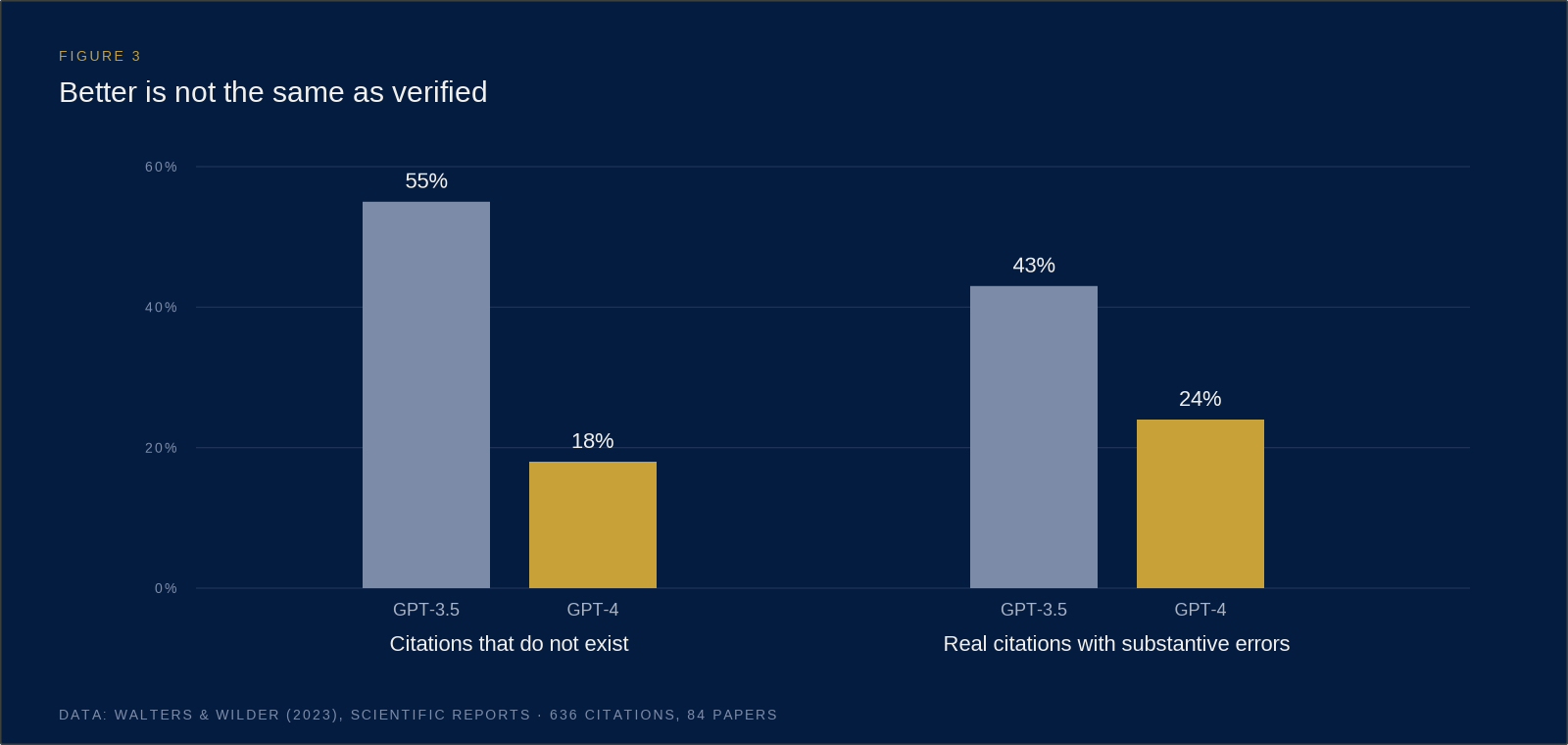
The improvement is real. It is also not zero, and newer models have not removed the obligation to check. Publishers agree. The Committee on Publication Ethics (2023) holds that AI tools cannot be listed as authors because they cannot take responsibility for the work, and the editor-in-chief of Science put it plainly: the tools are fun, but they are not authors (Thorp, 2023).
Keeping the right work human
Read through activity theory, a sensible AI workflow is a decision about the division of labour, made stage by stage.
- Discover. Let tools widen the search with citation maps from seed papers, semantic search and evidence summaries. Keep the inclusion decisions yours, and record why you kept or dropped a source.
- Read and synthesize. Question your own library of papers or anonymized transcripts with a tool that shows the passage it is drawing from. Read the passage before you quote it.
- Manage references. Use one reference manager as the hub, so every tool reads from and writes back to the same verified library.
- Write. Use models to restructure, tighten and check a draft against a reviewer's criteria. Do not let them generate the claims or the citations.
- Get feedback. A reviewer-style critique before submission is useful. Treat it as one more reviewer, not the final word.
- Disclose. Say what you used and for what, following your publisher's policy and current APA guidance on citing generative AI (McAdoo, 2023).
Some tools do not belong in this workflow at all: detector-bypass "humanizers," unlicensed paper repositories, and AI-written literature reviews submitted as finished text. Each one removes the traceability that makes research worth trusting.
A stack, held loosely
For practitioner-scholars working on their own time, five things cover most of the work: Zotero as the single library; NotebookLM for questioning your own sources; an evidence-search tool such as Consensus connected to a general model; ResearchRabbit with Semantic Scholar for mapping newer work from seed papers; and a reviewer-style critique before you send a draft to a colleague. Most are free. None replaces reading.
For research teams, labs and graduate programs, this is also a design opportunity. Formative interventions such as the Change Laboratory exist to help a group surface its own contradictions and redesign its practice together (Engeström, 2011; Sannino et al., 2016). A team deciding how AI enters its work is exactly the kind of group that method was built for.
The tools will change before this note is a year old. The activity will not. Research is still directed at knowledge that someone else can retrace, check and build on. Choose instruments that serve that object, and redesign the division of labour around them, rather than letting the instruments quietly redefine what the work is for.
Note on data: the channel analysis is my own review of publicly available video descriptions and auto-generated transcripts. Counts reflect descriptions containing a partner link and say nothing about sales or quality.
References
Blackler, F. (1995). Knowledge, knowledge work and organizations: An overview and interpretation. Organization Studies, 16(6), 1021–1046. https://doi.org/10.1177/017084069501600605
Bligh, B., & Flood, M. (2017). Activity theory in empirical higher education research: Choices, uses and values. Tertiary Education and Management, 23(2), 125–152. Open access: https://eprints.lancs.ac.uk/id/eprint/84025
Bloom, N., Han, R., & Liang, J. (2024). Hybrid working from home improves retention without damaging performance. Nature, 630, 920–925. https://doi.org/10.1038/s41586-024-07500-2
Committee on Publication Ethics. (2023). Authorship and AI tools [Position statement]. https://publicationethics.org/guidance/cope-position/authorship-and-ai-tools
Engeström, Y. (2001). Expansive learning at work: Toward an activity theoretical reconceptualization. Journal of Education and Work, 14(1), 133–156. https://doi.org/10.1080/13639080020028747
Engeström, Y. (2008). From teams to knots: Activity-theoretical studies of collaboration and learning at work. Cambridge University Press. https://doi.org/10.1017/CBO9780511619847
Engeström, Y. (2011). From design experiments to formative interventions. Theory & Psychology, 21(5), 598–628. https://doi.org/10.1177/0959354311419252
Engeström, Y. (2015). Learning by expanding: An activity-theoretical approach to developmental research (2nd ed.). Cambridge University Press. https://doi.org/10.1017/CBO9781139814744 (Original work published 1987)
Engeström, Y., & Sannino, A. (2010). Studies of expansive learning: Foundations, findings and future challenges. Educational Research Review, 5(1), 1–24. https://doi.org/10.1016/j.edurev.2009.12.002
Engeström, Y., & Sannino, A. (2021). From mediated actions to heterogenous coalitions: Four generations of activity-theoretical studies of work and learning. Mind, Culture, and Activity, 28(1), 4–23. https://doi.org/10.1080/10749039.2020.1806328
Hinds, P. J., & Kiesler, S. (Eds.). (2002). Distributed work. MIT Press.
Kaptelinin, V., & Nardi, B. A. (2006). Acting with technology: Activity theory and interaction design. MIT Press.
Kaptelinin, V., & Nardi, B. A. (2018). Activity theory as a framework for human-technology interaction research. Mind, Culture, and Activity, 25(1), 3–5. https://doi.org/10.1080/10749039.2017.1393089
Leont'ev, A. N. (1978). Activity, consciousness, and personality. Prentice-Hall.
Li, Y., Zhou, X., Yin, H., & Chiu, T. K. F. (2025). Design language learning with artificial intelligence (AI) chatbots based on activity theory from a systematic review. Smart Learning Environments, 12, Article 24. https://doi.org/10.1186/s40561-025-00379-0
Liang, W., Zhang, Y., Wu, Z., Lepp, H., Ji, W., Zhao, X., Cao, H., Liu, S., He, S., Huang, Z., Yang, D., Potts, C., Manning, C. D., & Zou, J. (2025). Quantifying large language model usage in scientific papers. Nature Human Behaviour. https://doi.org/10.1038/s41562-025-02273-8
Lindell, T., & Stöhr, C. (2026). Navigating generative AI in higher education: Six near future scenarios. Learning, Media and Technology, 51(3), 463–478. https://doi.org/10.1080/17439884.2025.2562405
Logan, F. (2026). How do technology professionals engage in distributed work? An activity systems analysis in corporate and educational organizations [Doctoral thesis, Lancaster University]. https://doi.org/10.17635/lancaster/thesis/3224
Martinez Marroquin, E., & Senadji, B. (2025). Activity theory as framework for analysis of workplace learning technologies: The case of generative AI conversational agents. International Journal of Information and Learning Technology, 42(4), 353–365. https://doi.org/10.1108/IJILT-07-2024-0141
McAdoo, T. (2023, April 7). How to cite ChatGPT. APA Style Blog. https://apastyle.apa.org/blog/how-to-cite-chatgpt
Messeri, L., & Crockett, M. J. (2024). Artificial intelligence and illusions of understanding in scientific research. Nature, 627, 49–58. https://doi.org/10.1038/s41586-024-07146-0
Olson, G. M., & Olson, J. S. (2000). Distance matters. Human–Computer Interaction, 15(2–3), 139–178. https://doi.org/10.1207/S15327051HCI1523_4
Sannino, A., Engeström, Y., & Lemos, M. (2016). Formative interventions for expansive learning and transformative agency. Journal of the Learning Sciences, 25(4), 599–633. https://doi.org/10.1080/10508406.2016.1204547
Tai, S.-H., Yeh, C.-C., Wang, J.-Y., Hu, R.-H., Lee, P.-H., & Ho, C.-M. (2026). Integration of ChatGPT in medical learning: An analysis of interaction and contradictions. Medical Teacher, 48(6), 1004–1011. https://doi.org/10.1080/0142159X.2025.2604245
Thorp, H. H. (2023). ChatGPT is fun, but not an author. Science, 379(6630), 313. https://doi.org/10.1126/science.adg7879
Van Noorden, R., & Perkel, J. M. (2023). AI and science: What 1,600 researchers think. Nature, 621, 672–675. https://doi.org/10.1038/d41586-023-02980-0
Vygotsky, L. S. (1978). Mind in society: The development of higher psychological processes (M. Cole, V. John-Steiner, S. Scribner, & E. Souberman, Eds.). Harvard University Press.
Walters, W. H., & Wilder, E. I. (2023). Fabrication and errors in the bibliographic citations generated by ChatGPT. Scientific Reports, 13, 14045. https://doi.org/10.1038/s41598-023-41032-5
Yang, L., Holtz, D., Jaffe, S., Suri, S., Sinha, S., Weston, J., Joyce, C., Shah, N., Sherman, K., Hecht, B., & Teevan, J. (2022). The effects of remote work on collaboration among information workers. Nature Human Behaviour, 6(1), 43–54. https://doi.org/10.1038/s41562-021-01196-4
Freddrick Logan, PhD
Educational technologist and applied researcher working across career readiness, credentialing and the systems underneath them.