I finished the first draft of my book. Now comes the part nobody warns you about: finding the hours to finish it.
The book is called The Great Distribution: How Distribution Is Reshaping Work, Learning, and Life. It grew out of my doctoral research on distributed technology professionals. The first draft is done: 15 chapters, five parts, roughly 29,000 words. That sounds like the finish line. It's closer to the halfway mark.
How the book is getting made
A dissertation and a trade book share research, not readers. My dissertation was written for examiners. This book is written for anyone whose job, classroom, or career now spans more than one place.
So the process has looked like this:
- 1. Translate. Turn academic findings into plain language and real stories.
- 2. Expand. The scope grew from remote work to distributed work and distributed learning, from high school through adult education.
- 3. Draft. Get every chapter down, rough edges and all.
- 4. Fill the gaps. Add new interviews, real voices, and the sections that frame the book.
- 5. Revise toward publisher-ready. Grow it to full trade length and tighten every page.
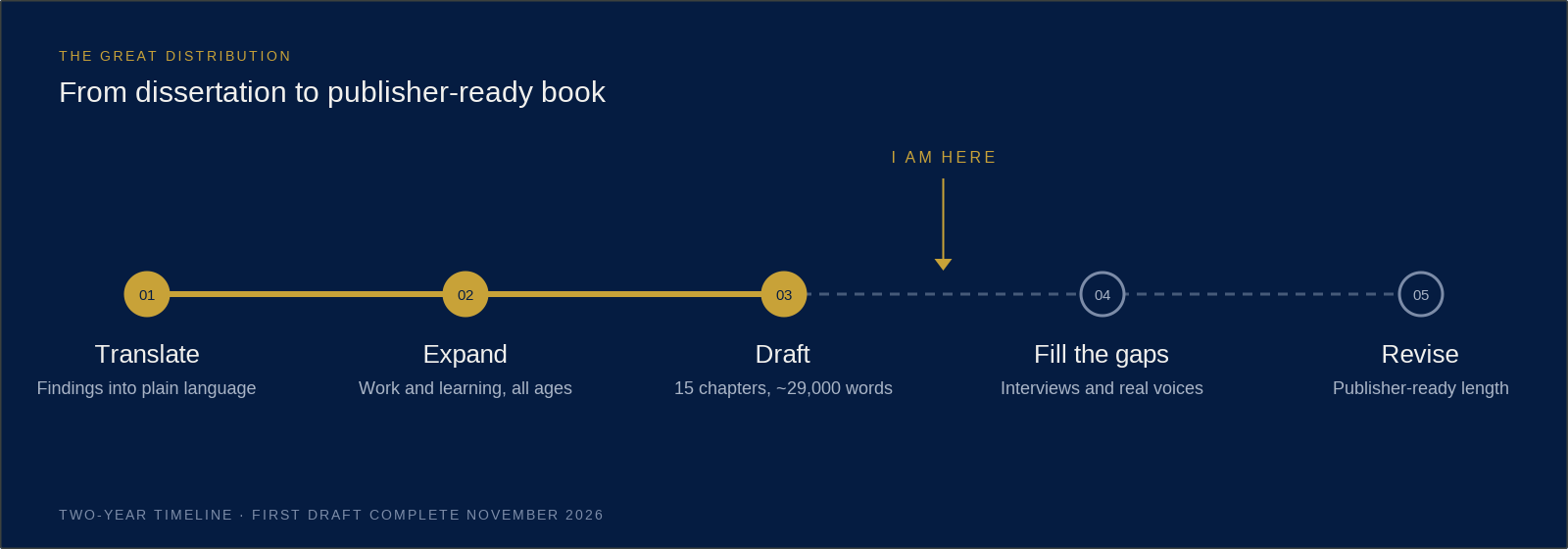
I'm between steps 3 and 4. I gave myself two years to get to step 5.
The MBA is part of the research, too. I didn't need another degree. My university offers it to me as a benefit of my service, and I'm treating the coursework as fieldwork for the book. Executive MBA study gives the book firmer grounding in corporate strategy and organizational practice, and helps connect what distributed work looks like on campus with how businesses actually lead and coordinate it.
This book is also part of a broader research agenda. Over the next two to four years, I will be developing parts of this work into journal articles and conference proceedings, ideally in collaboration with practitioners who lead and experience distributed work and learning firsthand. I intend for the book to take its final form midway through that period, informed by what those publications and presentations contribute.
This book is also part of a broader research agenda.
The hardest part: time
It isn't writer's block. Ideas are not the problem. Hours are.
I write around a full-time job, an executive MBA, teaching, and the rest of life. Every one of those has a deadline that arrives this week. The book's deadline arrives in two years. Guess which one loses on a busy Tuesday.
A few things I've learned so far:
- Urgent beats important. A book never sends a reminder email. If I don't protect the time, nothing else will.
- Momentum is fragile. Skip a week, and re-entry takes a full session just to remember where I was.
- Small blocks still count. Forty-five focused minutes moves a chapter. Waiting for a free Saturday doesn't.
- Solo work drifts. Without someone asking "how's the book?", it's easy to let a month slip.
"A book never sends a reminder email."
That last one is where you come in.
How you can help me finish it
Writing is solitary. Finishing doesn't have to be. Here's what would make a real difference:
- Ask me about it. Seriously. A quick "where's the book at?" is the best accountability I can get.
- Share your story. I'll soon be interviewing people about learning across distance: students, teachers, parents, adult learners, and trainers. If that's you, let me know and I'll reach out once interviews open.
- Collaborate on research. If you work in education, career services, workforce development, or on a distributed team and have experience or data worth examining, I welcome conversations about co-authoring a journal article or conference proposal. Practitioner perspectives are often underrepresented in this literature, and the work is stronger with them.
- Be an early reader. I'll need a small group to read chapters and tell me honestly what lands and what drags.
- Make an introduction. If you know an agent, editor, or publisher in nonfiction about work or education, I'd welcome a connection.
- Pass this along. Sharing this post helps me find the right readers and voices.
- Give me grace. If I'm slower to reply on a weekend, I'm probably writing.
Let's talk
If you want to talk about the writing process, compare notes on your own long project, or offer any of the help above, pick a time on my calendar: https://calendly.com/freddrick-logan/60min
Prefer to start with a message? Connect with me on LinkedIn and mention the book: https://linkedin.com/in/freddricklogan
The road from here
This book is about how work and learning are spreading out across places and people. It's fitting that finishing it will take a distributed effort too.
I'll post progress updates here as the chapters come together. If any of the above fits you, I'd love to hear from you.
Freddrick Logan, PhD
Educational technologist and applied researcher working across career readiness, credentialing and the systems underneath them.