On Thursday, November 12, 2026, beginning in the early afternoon Eastern time, Microsoft customers around the world found they could not reach their mailboxes. Microsoft's advisory warned that customers "may be unable to connect to multiple services," and by evening the company was describing the cause not as a surge in traffic but as "a number of servers being unexpectedly unavailable." As of that evening, Microsoft had not said when service would be fully restored (BleepingComputer, 2026).
The obvious lesson writes itself, and I have already seen it written several times: we have built professional life on a single fragile channel, and it is time to let email go.
I want to make the case for letting a great deal of email go. But not with this evidence, because this evidence points the other way.
Read the advisory's list again. Exchange Online, the email service, was on it. So were Microsoft Teams, SharePoint Online, Microsoft 365 Copilot, and Defender XDR (BleepingComputer, 2026). The organizations that had already "moved past email" onto Teams did not escape the outage. They were inside the same failure, because they had replaced one product with another product from the same vendor, running on the same infrastructure.
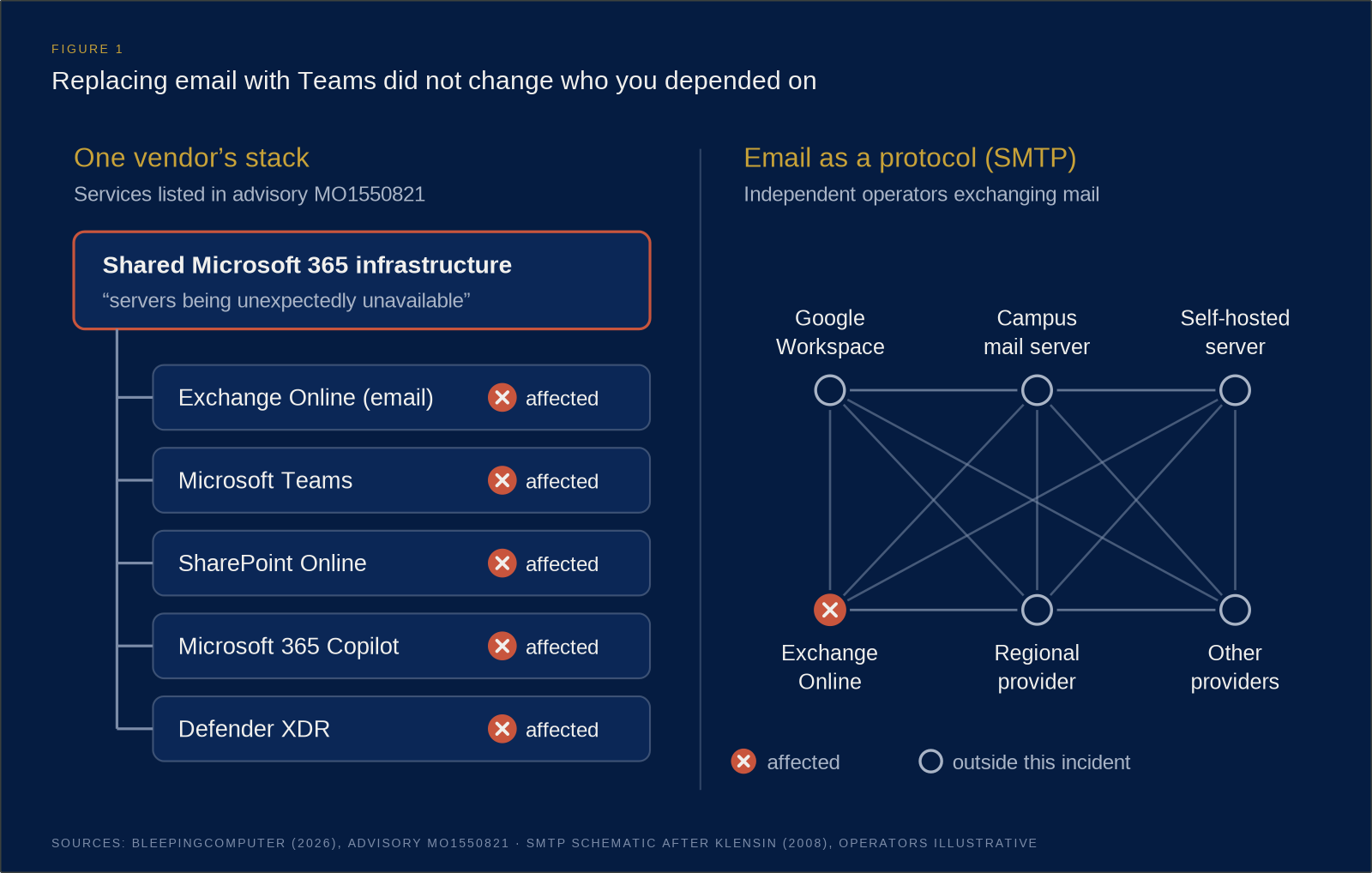
That distinction, between email as a practice and email as a protocol, is the whole argument of this post.
Email the protocol, email the practice
Email as a protocol is SMTP: an open standard that lets any operator's mail server deliver to any other's (Klensin, 2008). No one owns it. A university, a hospital, a sole proprietor, and a global firm can each run it on different infrastructure and still reach one another. That is a rare property in workplace software, and it is exactly the property that limits how far any one operator's failure can spread. What failed on November 12 was not email. It was one company's implementation of email, along with that company's alternatives to it.
Email as a practice is something else: the expectation that a message sent is a reply owed, that the inbox is the default container for coordination, that constant availability is a professional virtue. Almost every documented harm attributed to "email" is a harm of the practice.
The rest of this post makes the case for abandoning the practice, and argues that the protocol is the part worth keeping.
"What failed on November 12 was not email. It was one company's implementation of email, along with that company's alternatives to it."
What the evidence says the practice costs
Start with the cleanest causal test. Kushlev and Dunn (2015) had 124 adults limit email checking to three times a day for one week and check freely during another; daily stress was lower in the limited week. Mark, Voida, and Cardello (2012) cut 13 workers off from email for five days. They switched between windows less and held focus longer, though the physiological stress effect was only a trend, and with thirteen participants the study is best read as suggestive.
Mark et al. (2016), tracking 40 workers with computer logging and heart-rate monitoring, found that more time on email each day was associated with lower self-rated productivity and higher measured stress. They also found that batching email was not associated with lower stress. The easy fix does not obviously work. Wijngaards, Pronk, and Burger (2022) saw the same pattern in a field setting: a top-down batching intervention at a Dutch financial firm reduced email interruptions and emotional exhaustion, and the effect faded within about two weeks.
The deeper finding is structural. Mazmanian, Orlikowski, and Yates (2013) showed that mobile email gave professionals real individual flexibility, and that this flexibility, added up across a whole firm, escalated everyone's expectations of availability until autonomy shrank in practice. They called it the autonomy paradox. It is a finding about a norm, not a device.
And Barley, Meyerson, and Grodal (2011) add the complication any honest version of this argument has to carry. Email worked as both a source and a symbol of stress: time on email predicted a sense of overload, but email also absorbed the blame for overload that came from elsewhere. Abolish the inbox and some of that overload will simply go looking for a new symbol.
What happened when a company actually tried
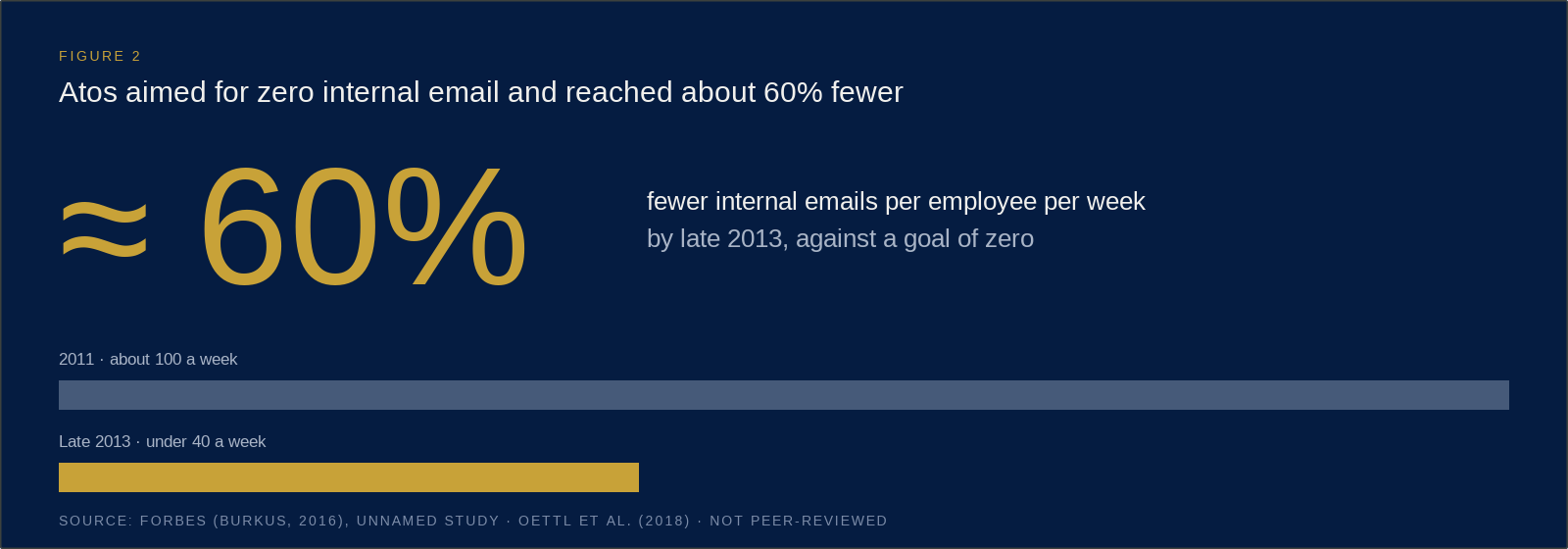
The most-cited attempt is Atos, whose chief executive announced in 2011 a goal of becoming a "zero email" company, replacing internal email with an enterprise social network across roughly 76,000 employees. The reported result was that weekly internal email per employee fell from about 100 to fewer than 40, roughly 60%, by late 2013. The company never reached zero, and progress reportedly stalled after 2014 (Burkus, 2016; Oettl et al., 2018).
Two cautions belong in any citation of this case. First, the 60% figure traces to an unnamed independent study reported in Forbes, and the fullest scholarly account is a teaching case built largely on seven expert interviews. As far as I can find, no peer-reviewed study reports productivity or well-being outcomes from Atos, or from any organizational email ban. That is a striking gap for an idea this popular.
Second, the burden tends to move rather than disappear. When instant messaging entered workplaces, employees used it in addition to email rather than instead of it, and experienced its interruptions as unfair (Cameron & Webster, 2005). In globally distributed software teams, Slack reduced reliance on email, and the same study documented nearly nine hours a week of unscheduled meetings (Stray & Moe, 2020). Tarafdar, Wenninger, and Stich (2023) locate overload not in email as such but in "email by default": reaching for email when another tool would fit the task better. The default travels with you to the next tool.
Reading it as an activity system
Here my own theoretical commitments do some real work. In cultural-historical activity theory, a tool never acts alone. It sits inside an activity system with rules, a community, and a division of labor (Engeström, 1987/2015).
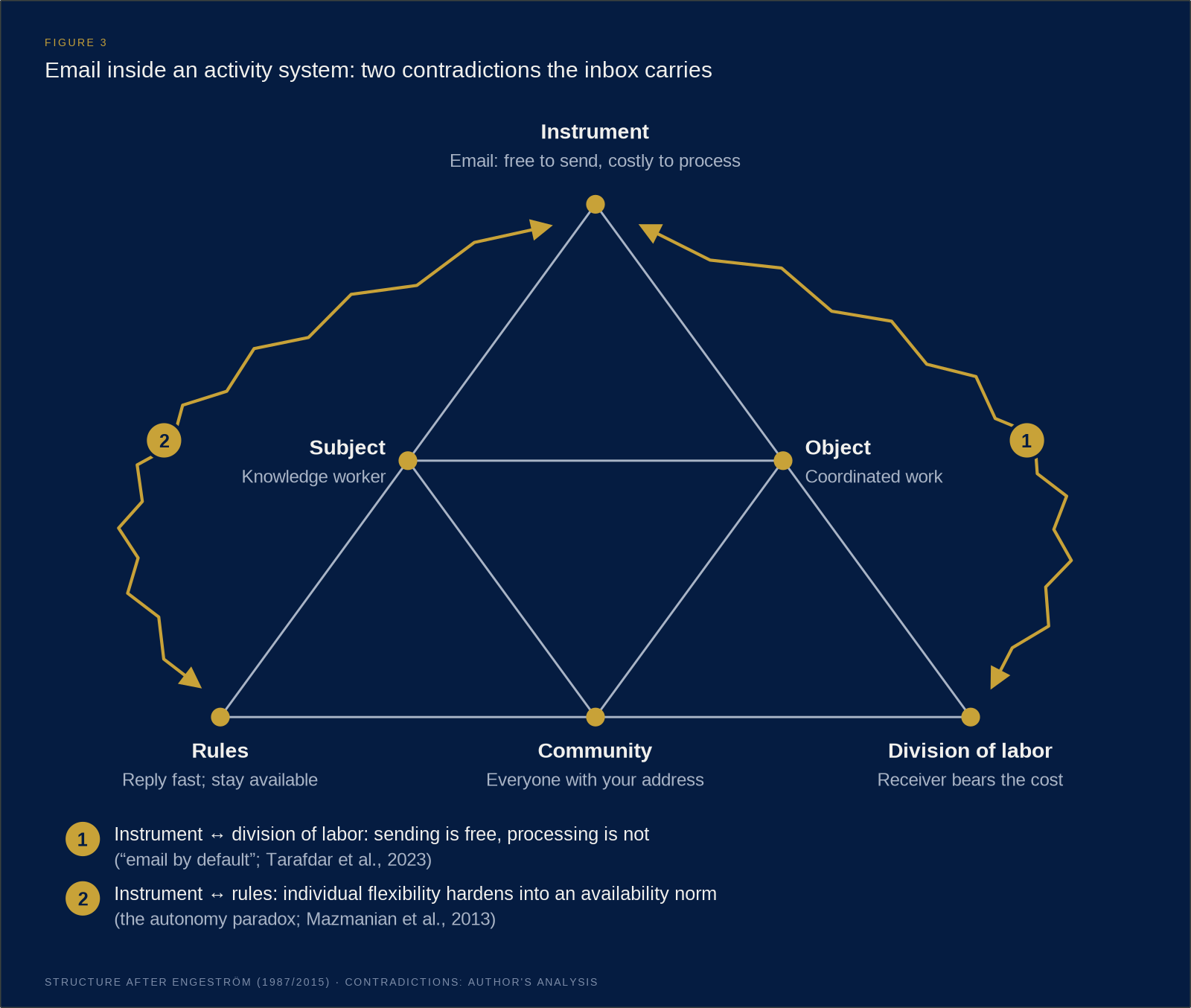
Email made sending nearly free for the sender while leaving processing costly for the receiver, and the division of labor was never renegotiated to match. That is a contradiction between the instrument and the division of labor. The availability norm that Mazmanian et al. (2013) document is a second contradiction, between the instrument and the rules.
This framing makes a prediction. If you try to resolve the contradiction by replacing only the instrument, swapping email for a chat platform while leaving the rules and the division of labor untouched, the contradiction should reappear inside the new tool. That is what the displacement evidence shows. Atos changed the instrument. The expectations about availability came along for the ride.
It also explains Barley et al.'s (2011) finding about symbols. As I have argued in Contradictions Are Not Problems (https://freddricklogan.com/notes/contradictions-are-not-problems), a contradiction that cannot be named at the level of the system gets absorbed at the level of the person. Email is the visible place where an invisible contradiction lands.
Remote work without email
Remote work is where the inbox question gets sharpest, because distributed work runs on asynchronous text.
Remote work is where the inbox question gets sharpest, because distributed work runs on asynchronous text.
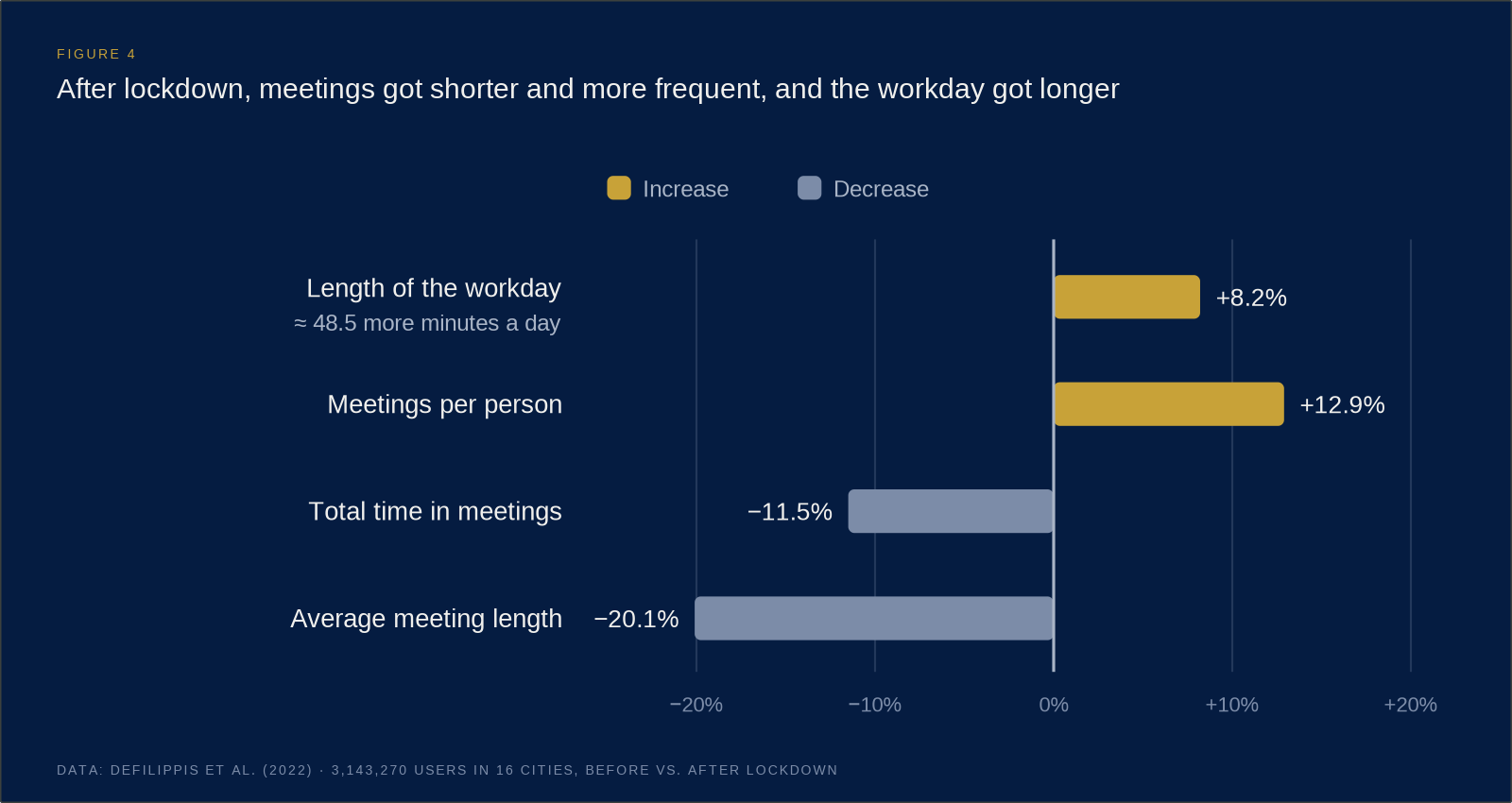
When the pandemic pushed knowledge work home, DeFilippis et al. (2022) analyzed communication metadata from more than 3.1 million users in 16 cities. Meetings per person rose 12.9%, average meeting length fell 20.1%, total time in meetings fell 11.5%, and the workday lengthened by 8.2%, about 48.5 minutes. Email activity rose too, at least in the short term. Yang et al. (2022), studying 61,182 Microsoft employees, found that firm-wide remote work made collaboration networks more static and siloed, and shifted communication from synchronous toward asynchronous forms.
So remote work without email does not mean remote work without asynchronous text. It means deciding where that text lives. Rhymer (2023), studying fully distributed organizations, identifies asynchronous-oriented patterns of collaboration alongside real-time-oriented ones; the asynchronous pattern is the one a post-inbox organization has to get right. My own reading of where that leads is a shift from the message, which is addressed, ephemeral, and owed a reply, to the record, which is written once, findable by anyone, and owed nothing. A well-kept handbook does the work of a thousand reply-all threads.
That is what a remote organization without email-as-default looks like: documentation as the system of record, synchronous time reserved for what genuinely needs it, and messaging demoted to signaling.
Academia: the hardest case
Higher education is where email is most entrenched and hardest to replace, for a structural reason. Academic work crosses institutional boundaries constantly: co-authors at other universities, external reviewers, editors, prospective students, alumni. No single institution's collaboration platform reaches all of them. Email's interoperability is load-bearing in academia in a way it is not inside a single firm.
The costs are real all the same. Academic staff report higher email volume than professional staff, and use fewer strategies to manage it (Pignata et al., 2015). In one business school, bulk institutional email alone was estimated to cost more than a quarter of a million dollars a year, nearly $1,000 for each message sent to everyone (Bicudo de Castro, 2025).
So academia without email-as-default is plausible inside the institution (announcements on a single findable page, committee work in shared documents, advising through booking systems instead of threads) and implausible at its edges, where email remains the only common protocol scholars share.
The case for keeping it, stated fairly
Email's defenders have evidence too, and it deserves a full hearing. In early field research, much of what employees sent by email would not have been communicated at all through any other medium, and email flattened status differences (Sproull & Kiesler, 1986). Over a 44-week project, email's persistence and editability supported team learning (Erhardt et al., 2016). A systematic review covering 25 years of research concludes that the problem is how email is used, through access boundaries and triage, rather than the medium itself (Russell et al., 2024).
One argument should give abolitionists real pause. In one study, autistic adults generally preferred email when contacting unfamiliar people or organizations, and found phone calls very unpopular (Howard & Sedgewick, 2021). A workplace that replaces asynchronous text with calls and live meetings has made an accessibility decision, whether it meant to or not.
A note on privacy
There is one more cost of replacing email that rarely gets counted. The platforms that replace the inbox, with their presence indicators, read receipts, and activity dashboards, generate far richer behavioral data than email does. The Yang et al. (2022) study was itself possible because one vendor holds communication telemetry on tens of thousands of its own employees. That telemetry is useful for research. It is also infrastructure for monitoring, and U.S. law places few meaningful limits on employer surveillance (Ajunwa et al., 2017). On Nissenbaum's (2004) account of contextual integrity, the question is not simply whether data is collected but whether its flow matches the norms of the context it came from. "Who read my message, when, and on which device" is a flow that email mostly never created.
What I would actually propose
The regulatory trend points the same way the theory does.
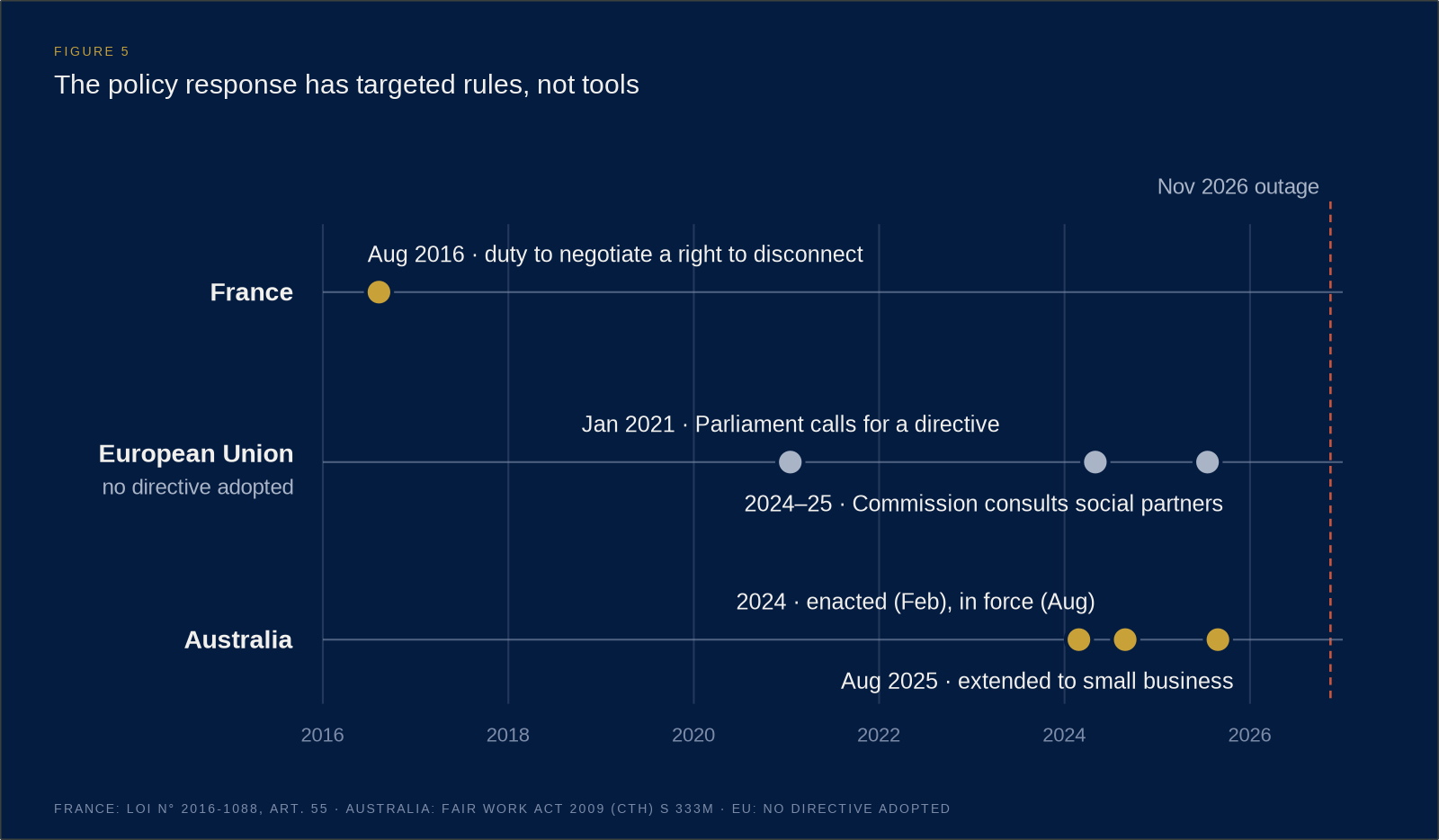
France and Australia did not ban email. They changed the rules. France's 2016 labor law obliged employers to negotiate how a right to disconnect would work, or else to issue a charter. Australia's 2024 amendment lets employees refuse to monitor, read, or respond to contact outside working hours unless the refusal is unreasonable. Both act on the rules of the activity system, which is where the contradiction actually lives.
So, four proposals:
- Change the rules before the tools. Set explicit response-time norms and protected offline time. Predictable time off has already been field-tested with management consultants (Perlow & Porter, 2009).
- Move the system of record from inboxes to documents. Decisions, policies, and status belong somewhere findable, not in a thread someone has to be copied on.
- Keep email for crossing boundaries: the external, the occasional, and the formal record, where its interoperability is the point.
- Refuse single-vendor consolidation of every channel. Resilience means one operator's failure is not the failure of all communication.
The claim
The November outage did not show us what work looks like without email. It showed us what work looks like with only one email, and one chat, and one document store, all behind the same failing servers.
Drop email as the default. Keep it as the protocol. The inbox was never the problem; the obligation it carried was.
References
Ajunwa, I., Crawford, K., & Schultz, J. (2017). Limitless worker surveillance. California Law Review, 105(3), 735–776.
Barley, S. R., Meyerson, D. E., & Grodal, S. (2011). E-mail as a source and symbol of stress. Organization Science, 22(4), 887–906. https://doi.org/10.1287/orsc.1100.0573
Bicudo de Castro, V. (2025). Quantifying the burden of organisational bulk emails in a business school. Higher Education Research & Development, 44(8), 1934–1948. https://doi.org/10.1080/07294360.2025.2510662
BleepingComputer. (2026, November 12). Massive Microsoft 365 outage disrupts Outlook, Teams, Copilot worldwide. https://www.bleepingcomputer.com/news/microsoft/massive-microsoft-365-outage-disrupts-outlook-teams-copilot-worldwide/
Burkus, D. (2016, July 12). Why Atos Origin is striving to be a zero-email company. Forbes. https://www.forbes.com/sites/davidburkus/2016/07/12/why-atos-origin-is-striving-to-be-a-zero-email-company/
Cameron, A. F., & Webster, J. (2005). Unintended consequences of emerging communication technologies: Instant messaging in the workplace. Computers in Human Behavior, 21(1), 85–103. https://doi.org/10.1016/j.chb.2003.12.001
DeFilippis, E., Impink, S. M., Singell, M., Polzer, J. T., & Sadun, R. (2022). The impact of COVID-19 on digital communication patterns. Humanities and Social Sciences Communications, 9, Article 180. https://doi.org/10.1057/s41599-022-01190-9
Engeström, Y. (2015). Learning by expanding: An activity-theoretical approach to developmental research (2nd ed.). Cambridge University Press. (Original work published 1987)
Erhardt, N., Gibbs, J., Martin-Rios, C., & Sherblom, J. (2016). Exploring affordances of email for team learning over time. Small Group Research, 47(3), 243–278. https://doi.org/10.1177/1046496416635823
Fair Work Act 2009 (Cth) s 333M (Austl.), inserted by the Fair Work Legislation Amendment (Closing Loopholes No. 2) Act 2024.
Howard, P. L., & Sedgewick, F. (2021). "Anything but the phone!": Communication mode preferences in the autism community. Autism, 25(8), 2265–2278. https://doi.org/10.1177/13623613211014995
Klensin, J. (2008). Simple Mail Transfer Protocol (RFC 5321). Internet Engineering Task Force. https://doi.org/10.17487/RFC5321
Kushlev, K., & Dunn, E. W. (2015). Checking email less frequently reduces stress. Computers in Human Behavior, 43, 220–228. https://doi.org/10.1016/j.chb.2014.11.005
Loi n° 2016-1088 du 8 août 2016 relative au travail, à la modernisation du dialogue social et à la sécurisation des parcours professionnels, art. 55 (Fr.).
Mark, G., Iqbal, S. T., Czerwinski, M., Johns, P., Sano, A., & Lutchyn, Y. (2016). Email duration, batching and self-interruption: Patterns of email use on productivity and stress. In Proceedings of the 2016 CHI Conference on Human Factors in Computing Systems (pp. 1717–1728). ACM. https://doi.org/10.1145/2858036.2858262
Mark, G., Voida, S., & Cardello, A. (2012). "A pace not dictated by electrons": An empirical study of work without email. In Proceedings of the SIGCHI Conference on Human Factors in Computing Systems (pp. 555–564). ACM. https://doi.org/10.1145/2207676.2207754
Mazmanian, M., Orlikowski, W. J., & Yates, J. (2013). The autonomy paradox: The implications of mobile email devices for knowledge professionals. Organization Science, 24(5), 1337–1357. https://doi.org/10.1287/orsc.1120.0806
Nissenbaum, H. (2004). Privacy as contextual integrity. Washington Law Review, 79(1), 119–158.
Oettl, C. A., Beck, K., Raufer, F. M., Priglmeir, A. T., Böhm, M., & Krcmar, H. (2018). Zero email initiative: A critical review of change management during the introduction of enterprise social networks. Journal of Information Technology Teaching Cases, 8(2), 172–183. https://doi.org/10.1057/s41266-018-0033-y
Perlow, L. A., & Porter, J. L. (2009). Making time off predictable—and required. Harvard Business Review, 87(10), 102–109.
Pignata, S., Lushington, K., Sloan, J., & Buchanan, F. (2015). Employees' perceptions of email communication, volume and management strategies in an Australian university. Journal of Higher Education Policy and Management, 37(2), 159–171. https://doi.org/10.1080/1360080X.2015.1019121
Rhymer, J. (2023). Location-independent organizations: Designing collaboration across space and time. Administrative Science Quarterly, 68(1), 1–43. https://doi.org/10.1177/00018392221129175
Russell, E., Jackson, T. W., Fullman, M., & Chamakiotis, P. (2024). Getting on top of work-email: A systematic review of 25 years of research to understand effective work-email activity. Journal of Occupational and Organizational Psychology, 97(1), 74–103. https://doi.org/10.1111/joop.12462
Sproull, L., & Kiesler, S. (1986). Reducing social context cues: Electronic mail in organizational communication. Management Science, 32(11), 1492–1512. https://doi.org/10.1287/mnsc.32.11.1492
Stray, V., & Moe, N. B. (2020). Understanding coordination in global software engineering: A mixed-methods study on the use of meetings and Slack. Journal of Systems and Software, 170, Article 110717. https://doi.org/10.1016/j.jss.2020.110717
Tarafdar, M., Wenninger, H., & Stich, J.-F. (2023). Email overload: Investigating technology-fit antecedents and job-related outcome. ACM SIGMIS Database, 54(2), 77–96. https://doi.org/10.1145/3595863.3595869
Wijngaards, I., Pronk, F. R., & Burger, M. J. (2022). For whom and under what circumstances does email message batching work? Internet Interventions, 27, Article 100494. https://doi.org/10.1016/j.invent.2022.100494
Yang, L., Holtz, D., Jaffe, S., Suri, S., Sinha, S., Weston, J., Joyce, C., Shah, N., Sherman, K., Hecht, B., & Teevan, J. (2022). The effects of remote work on collaboration among information workers. Nature Human Behaviour, 6(1), 43–54. https://doi.org/10.1038/s41562-021-01196-4 (A published author correction, https://doi.org/10.1038/s41562-021-01228-z, relabels a figure key; the findings are unchanged.)
Freddrick Logan, PhD
Educational technologist and applied researcher working across career readiness, credentialing and the systems underneath them.